Consider the upcoming quarter and the high-stakes meeting for which you are currently preparing: the talent calibration session, the promotion committee review, or the annual evaluation where your name will finally be weighed against the names of your peers. You have meticulously assembled your case the metrics are undeniable, the delivered mandates are mapped, and the quarters you successfully closed under severe structural constraints are fully documented. You enter this cycle believing that this specific, formal room is where your professional destiny will be decided.
It is not. It is merely the room where a decision already reached weeks or months ago is formally read into the institutional record.
The nagging unease you have carried throughout your career the persistent sense that certain corporate outcomes arrive pre-loaded, that specific names move with a smooth inevitability your own has never quite possessed is not an expression of insecurity. It is an entirely accurate perception of an unwritten system that no one described to you. The corporate performance review is not the trial; it is the sentencing. By the time you step up to the podium to plead your case, the verdict has been settled law for months.
This represents the central misallocation of the high performer’s professional career. You have over-indexed on and optimized the visible window the appraisal forms, the quarterly deliverables, the formal moments of assessment operating on the flawed assumption that institutions evaluate output at the formal point of decision. They do not. The institution merely ratifies a consensus that was assembled long beforehand, in casual conversations you were never party to, conducted by senior stakeholders whose judgments had already hardened before your formal evidence even existed.
There is a corporate asymmetry at work here, and it is absolute. You experience the promotion or the executive elevation as an event. The individuals deciding it experience it as the closing entry on an institutional process that has been running quietly for over a year. You prepared a brilliant argument; the market, however, had already cleared.
What follows is an anatomical breakdown of that corporate settlement layer: where career elevation is actually transacted, why raw competence is systematically the wrong instrument to bring to it, and the specific strategic countermeasure required to relocate your career equity to the only period where the decision is genuinely live.
Prefer a visual breakdown?
Watch the video adaptation of this essay below before diving into the full strategic framework:
1. The Historical Anatomy of Power: How the Antechamber Outlasts the Throne Room
The mechanism governing modern corporate advancement is not a product of contemporary management theory or modern HR design. It is one of the oldest, most durable structures in the history of organized human power. When we strip away the modern corporate jargon of “talent matrices” and “succession planning,” we find a timeless blueprint that has governed empires, epic narratives, and royal courts for millennia, exposed with unusual clarity through three traditions.
The Tragedy of Ajax: Optimizing the Wrong Arena
In the classical account of the Trojan War, following the death of Achilles, his divine, irreplaceable armor the single most valuable strategic asset in the Greek camp had to be allocated. It was not awarded by combat or objective performance metrics, but by a formal vote of the command leadership.
Ajax was, by all objective metrics, the superior warrior, and no one disputed this, least of all Ajax himself. Yet, when the command convened to award the asset, the arms did not go to the top individual contributor. They were awarded to Odysseus, whose structural advantage lay entirely outside the visible window of combat. His advantage existed in the case he had been constructing, quietly, continuously, and informally, within the council tents of the leadership long before the award committee was ever formally convened.
Ajax optimized the battlefield; Odysseus optimized the room. In doing so, Ajax made the fatal error that destroys countless corporate executives today: he assumed the contest measured soldiering. It did not; it measured the case made on his behalf in his absence, and Odysseus had been making his for years.

The Selection at Kurukshetra: Resource vs. Validation
A parallel principle emerges within the Eastern epic tradition on the eve of the war at Kurukshetra. The rival commanders approached the sovereign figure of Krishna to solicit his backing for the coming conflict, and each was offered a fundamental strategic choice: they could choose either his vast standing armies, or his unarmed personal counsel as a non-combatant advisor.
Duryodhana, optimizing for visible, quantifiable resources and raw capacity, immediately claimed the divisions of armed troops. Arjuna, conversely, selected the advisor the strategic validator who would lift no weapon on the battlefield, but who would occupy the absolute center of the decision-making apparatus, read the field, and lend his immense structural authority to Arjuna’s cause at the exact moments where institutional weight mattered most.
Functionally, the entire multi-day engagement was settled not on the bloody plain that followed, but in the micro-moment of that selection. One side acquired raw operational capacity; the other acquired the most powerful absentee advocate available, positioned precisely where outcomes are confirmed.
The Architecture of the Antechamber: Versailles and the Ottoman Court
Centuries later, this exact same mechanism simply discarded its armor and put on European court dress. At the Palace of Versailles, advancement and royal favors were transacted during the king’s morning levée a highly restricted, deeply informal ritual where a select few were permitted to attend the monarch as he woke. The formal administrative appointment that followed weeks later was merely the administrative residue of an intimacy already secured.
Similarly, within the Ottoman palace, high office was rarely brokered within the public divan. It was negotiated within the inner chambers among favorites, advisors, and validators long before any public investiture took place. The public throne room did not create agreements; it sealed agreements that had already been struck in the antechamber.
The costume changes seamlessly across cultures, geographies, and centuries, but the underlying structure never does. Power is systematically allocated in private, among a small, highly coordinated set of validators, and then performed in public as though the performance were the actual cause of the outcome.
2. The Modern Corporate Mechanism: Sponsorship Traffic and Soft-Anchoring
When you strip away the historical costuming and translate this timeless dynamic into the language of the modern enterprise, the mechanism becomes clinical in its precision. A promotion to the executive or director level is not an objective reward for historical services rendered; it is the mathematical output of accumulated sponsorship traffic the volume and seniority of people who advocate for your name when you are not in the room combined with reputation signals socialized across the deciding body over a rolling window of roughly six to eighteen months. The formal talent calibration meeting does not generate this consensus through objective debate; it merely discovers a consensus that has already been formed.
The Three Diagnostic Questions
This reality creates a massive, unpriced systemic exposure that most high performers carry throughout their careers. You can run the structural diagnostics on your own current role right now, and the answers are frequently uncomfortable:
- First: When you are completely absent from a senior discussion regarding organizational talent, is your name raised spontaneously by someone other than your immediate direct manager?
- Second: Does anyone possessing structural power within the organization stand to lose something tangible personal credibility, a critical resource, or a commitment they have made if you are passed over for this elevation?
- Third: Has your name been spoken, favorably, contextually, and specifically, in at least one executive room that your current title does not permit you to enter?
If you cannot answer with a definitive “yes” to these questions, you do not have a performance problem. You have an advocacy vacuum, and the fundamental law of corporate mechanics is that no quantity of raw operational output will ever fill that vacuum at the formal point of decision.
The Physics of Soft-Anchoring
This advocacy vacuum exists because the overwhelming majority of professionals treat reputation as if it were a vague, atmospheric mist. In reality, a corporate reputation is a physical, traceable trail of intentional socialization the literal residue of your name left behind in an antechamber after you have exited it.
Within the twelve to eighteen months preceding an executive verdict, an effective candidate’s name must undergo a deliberate process of institutional normalization. When a high-ranking validator mentions your strategic capability in a casual setting a brief hallway exchange, a pre-meeting buffer, or a flight they are not asking the organization to make an immediate decision. Instead, they are executing a soft-anchor, subtly injecting your name into the leadership lexicon and testing the room’s resistance to your eventual elevation.
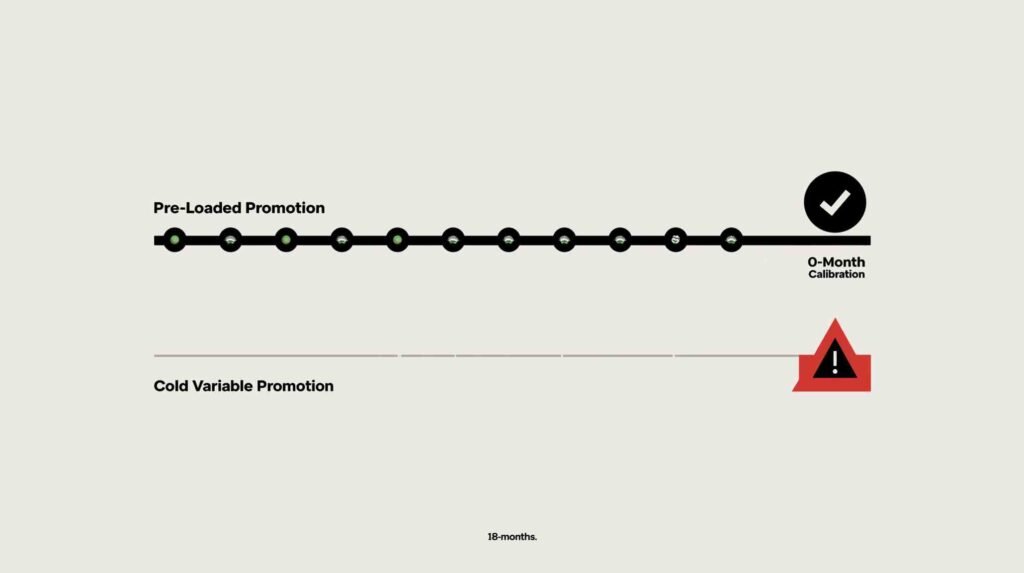
If the room remains silent, the lack of immediate velocity is logged by the validator as passive resistance; they note that your name carries no currency. However, if the room nods, the normalization process deepens. By the time the formal calibration meeting occurs, the deciding body has already sampled your promotion dozens of times. The formal vote is merely the final confirmation of an established habit. The profound tragedy of the un-sponsored high performer is that their name is never sampled. It arrives on the calibration slide deck as a cold variable and in a high-stakes, risk-averse corporate institution, cold is structurally synonymous with risky. The board does not actively reject your results; they reject the suddenness of your candidacy.
3. The Twin Failures of the Un-Sponsored High Performer
When an executive attempts to navigate an organization without understanding this settlement layer, their career inevitably hits one of two distinct structural failure points.
Failure Point 1: The Transactional Blind Spot
The first failure point is the transactional blind spot. Consider a functional Director who delivers the strongest numbers in her entire division measurable, defensible, and objectively unarguable. When the calibration committee meets, her name surfaces on the screen, and her direct manager offers a competent, entirely generic endorsement.
Immediately afterward, a peer’s name surfaces. This peer has delivered weaker operational results, but he is championed intensely by a Vice President who has, across two quarters, repeatedly attached this peer’s name to a highly visible, enterprise-wide strategic priority of his own.
The peer is promoted; the functional Director is passed over. The committee did not make an error; they rationally weighted a heavily sponsored, thoroughly pre-socialized candidate over an unsponsored, cold variable. The Director’s numbers were real, but they were simply not the variable under active assessment in that room.
Failure Point 2: The Accountability Vacuum
The second failure point is structural rather than transactional, and it hits those who misinterpret a single strong relationship for broad institutional sponsorship. An operator spends quarters building a deep relationship with a single powerful executive sponsor. Then, a sudden corporate reorganization moves that sponsor out of the deciding business unit or body.
His advocacy capital, concentrated entirely within a single node, evaporates overnight. He enters the calibration cycle with a magnificent portfolio of achievements, but the position at the table is now empty. This is the accountability vacuum at its purest: a modern corporate institution feels absolutely no systemic obligation to a name that no one left in the room is personally, politically, or operationally invested in defending.
The Behavioral Science of the Room
To understand why this happens, we must look at the behavioral science that governs senior leadership teams. Decision-makers do not enter a calibration room neutral; they arrive heavily anchored, carrying a pre-formed candidate whose name was socialized into their judgment over the preceding months.
- Anchoring Bias: Sets the baseline reference point; everything that follows is measured against it.
- Confirmation Bias: Shifts the objective deliberation into a targeted search for evidence that ratifies the pre-formed anchor, rather than a genuine re-litigation of it.
The data you present is not weighed objectively; it is filtered through a conclusion that already exists in the minds of the leadership. This is not corporate corruption; it is ordinary human cognition operating under severe time pressure and seeking social proof. This makes the dynamic far more durable and difficult to defeat than actual corruption, because no single individual in the room experiences themselves as being biased.
There is a quiet, continuous test running in every organization across the globe: not whether you are good at your job, but whether you are spoken of consistently and specifically well in rooms you will never enter. Most high performers pass the first test annually, and fail the second for decades without ever learning that the second test existed.
![A conceptual editorial graphic depicting the words "DATA" and "METRICS" passing through a highly selective cognitive filter shaped like an executive silhouette, with only pre-approved conclusions emerging on the other side.]](https://corporateascent.com/wp-content/uploads/2026/07/Data_Metrics.jpg)
4. The Countermeasure: Mastering the Antechamber Protocol
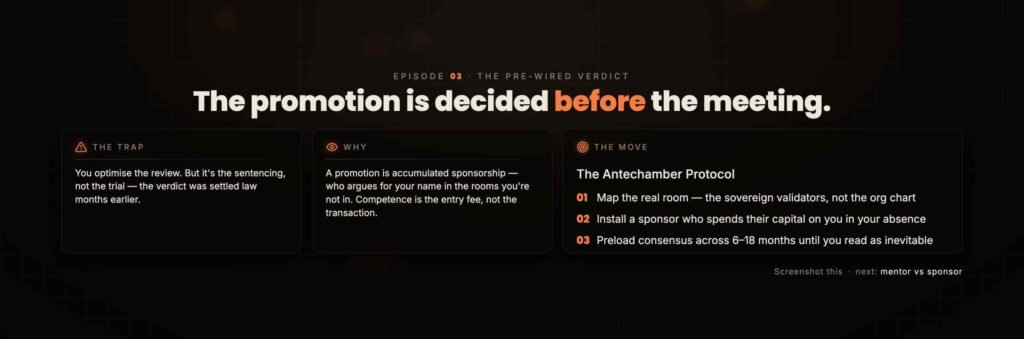
The strategic countermeasure to this systemic reality follows directly from the mechanism itself: if the final decision is inevitably anchored long before the formal meeting occurs, then the only viable career strategy is to systematically become the anchor before the meeting is ever scheduled. This is an intentional, rigorous executive discipline, not a natural behavioral instinct, and it requires the deployment of a methodology we can formalize as The Antechamber Protocol three sequential operations executed precisely within the open window where the institutional decision is actually live.
Operation 1: Room Mapping and the Org-Chart Fallacy
The protocol begins with Room Mapping. This operation requires you to identify, explicitly by individual name, the human beings who will actually ratify the decision regarding your level not the formal, vertical lines of the corporate org chart, but the actual set of human beings present and influential in the calibration of your level.
The fatal execution error made by mid-to-senior professionals is the org-chart fallacy, where operators look exclusively for titles rather than mapping the sovereign validators. In almost every talent calibration environment, there is a specific individual who does not necessarily hold the highest title, but whose silence or slight nod can instantly kill a candidacy. This individual is the person the other executives quietly look to for permission to agree. If you map the Vice President but ignore the sovereign validator whom that Vice President quietly defers to, your anchor will fail the moment it enters the room.
Operation 2: Sponsor Installation and the Advocacy Tax
The second operation is Sponsor Installation. It is critical here to discard the soft, generic definitions of corporate support: a mentor is someone who advises you in private, while a sponsor is someone who actively expends their own hard-earned political capital on you in public, specifically in your absence. You require at least one genuine, structurally secure sponsor inside that mapped room someone with structural power who will voice your name when you are absent, and who has a clear, operational reason of their own to do so.
This installation process carries an absolute, unyielding constraint: the advocacy tax. When a senior leader speaks for your elevation in the antechamber, they are spending a finite, highly volatile currency of internal political credibility. If they advocate intensely for your promotion and you subsequently underperform at the next level, they pay the tax their own judgment is questioned, their standing is diminished, and their future mandates shrink.
Therefore, your approach to installing a sponsor can never take the form of a request for assistance. It must be structured as a cold demonstration of low-risk yield. You must consistently prove to the potential sponsor that elevating you is the safest, most efficient available mechanism for them to protect or expand their own personal organizational mandate. You are not asking them to take a risk on your behalf; you are offering them a strategic win that you have already quietly secured on the ground. You provide the high-grade ammunition; they simply provide the institutional clearance required to fire it.
Operation 3: Consensus Pre-Loading and Structural Arbitrage
The final operation is Consensus Pre-Loading. Across the six-to-eighteen-month window leading up to the review, your name must be systematically socialized into adjacent rooms you are not yet permitted to enter, until your eventual candidacy reads to the leadership team as an historical inevitability rather than an active argument.
This is an exercise in structural arbitrage: you are actively exploiting the massive temporal gap between when the institution believes it decides and when it actually decides. You are not lobbying for a favorable verdict at the end of the trial; you are installing the standard reference point against which every other candidate will be measured before the trial even begins.
5. The Protocol in Action: A Case Study in Executive Elevation
To see this protocol function in the real world, consider the contrasting approaches of two functional directors operating within the same firm, both positioned fourteen months ahead of an executive promotion cycle.
The Reactive Approach: The Meticulous Defender
Director A is a textbook high performer who believes explicitly in the formal meritocracy of the organization. He views the upcoming promotion cycle as a grand court case where the person with the most complete evidence wins. He spends fourteen months keeping his head down, driving his teams to ship products ahead of schedule, documenting every launch, and calculating the exact ROI of his division to the decimal point. He preserves his case entirely for the formal review window, confident that the sheer weight of his thoroughness will compel the committee to elevate him.
When the calibration meeting occurs, his name is displayed, and his manager presents his metrics. The room looks at the data, nods politely, and notes that Director A is a tremendous operational asset. Then, a sovereign validator at the end of the table speaks up: “He’s incredibly solid where he is, but I haven’t seen him operate at the strategic level. Let’s keep him in place for another cycle to see how he scales.” The manager lacks the political capital to push back against the validator. The room murmurs agreement, slides the deck to the next name, and the verdict is sealed. Director A prepared a perfect defense for a verdict entered into the institutional record three months prior. Thoroughness, when deployed precisely too late, is completely indistinguishable from negligence.
The Proactive Approach: The Architectural Anchor
Director B operates entirely within the framework of the Antechamber Protocol. Fourteen months out from the exact same cycle, she sits down and completely ignores the corporate org chart. Instead, she maps the true calibration panel for her level, identifying the single Senior Vice President whose core strategic mandate her team’s technical output can directly accelerate.
She explicitly avoids engaging in transparent, transactional lobbying, and she never bypasses her immediate manager a sloppy political move that would trigger an immediate defensive alignment against her candidacy. Instead, she systematically adjusts her team’s internal roadmaps to ensure that their output makes that specific SVP’s personal strategic priorities measurably more successful.
She ensures this contribution is made completely legible to her immediate manager first, providing him with the narrative ammunition he needs. She then orchestrates cross-functional workflows that ensure this visibility radiates naturally upward. This gives the target SVP a powerful, self-interested reason to attach Director B’s name to the major enterprise outcomes he is personally accountable to the leadership for delivering.
Over the next three quarters, Director B’s name enters adjacent executive forums repeatedly, carried not by her own voice, but voiced spontaneously by the SVP during alignment calls. She is soft-anchored as a critical strategic thinker long before anyone mentions the word “promotion”. When the calibration panel finally convenes, Director B is not a candidate undergoing an intense, high-stakes evaluation; she is simply the established institutional consensus being formally confirmed. The meeting, for her, is nothing more than administrative residue.
6. Competence Is the Entry Fee, Not the Transaction
None of this structural analysis should be misinterpreted as an argument against the pursuit of operational excellence or raw competence. Competence remains the absolute, non-negotiable precondition for long-term career progression. It is the baseline asset that makes you eligible for sponsorship in the first place; no sane executive will expend political capital to sponsor an incompetent operator.
But it is vital to separate the foundation from the architecture: competence is the entry fee required to get into the building; it is not the transaction that takes place once you are inside. The actual transaction of professional elevation is advocacy, conducted entirely in advance, inside rooms you will never personally see.
This exposes the next major fault line in corporate execution the hidden barrier that quietly ends promising executive careers just as they reach senior management. The entire architecture of the Antechamber Protocol rests upon a profound operational distinction that the vast majority of professionals fail to draw with precision: the massive structural difference between a mentor and a sponsor.
These two roles are not adjacent points on a friendly spectrum of corporate support. They are entirely different instruments, operating in different arenas, and they cost the other party completely different things. The professional who confuses the two will spend years cultivating warm, supportive relationships that feel incredibly valuable during one-on-one sessions, but produce absolutely zero velocity at the actual moment of institutional decision.
The mentor improves you; the sponsor spends on you. Knowing which one you actually have and which one you have been dangerously mistaking for the other is the precise difference between being beautifully prepared for a review, and actually being promoted.
That distinction is the subject of what comes next.
Our Linkedin Post: https://www.linkedin.com/pulse/performance-review-trial-sentencing-corporate-ascent-yexcc